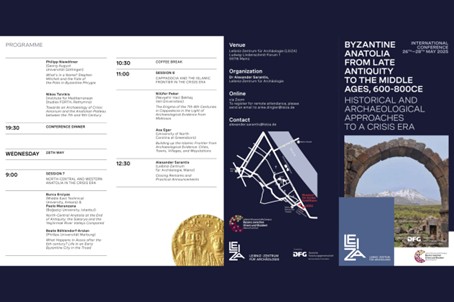
Hybrid Conference in Mainz, Germany: Byzantine Anatolia from Late Antiquity to the Middle Ages, 600-800: Historical and Archaeological Approaches to a Crisis Era
26-28 May, 2025
Anatolia was the only sizeable landmass which remained part of the Byzantine empire following a series of wars during the seventh and early eighth centuries. The empire lost control over most of the Balkans following the immigration of various tribal groups south of the River Danube, while its eastern provinces (northern Mesopotamia, Syria and the Levant and Egypt) fell first to the Sassanid Persians (603-628) and then the early Islamic Arab armies (634-54). The north African territories had been conquered by the Arab armies by the end of the seventh century. Anatolia, though, held out, in spite of a series of raids, first by the Sassanid Persians (609-626) and then by the Muslim armies from ca. 641. This vast, diverse and often inhospitable peninsula (broadly speaking correlating with modern Asian Turkey, north-east of the Taurus Mountains and east of the Middle to Upper Euphrates River) is often viewed as a buffer zone and for the most part a backwater, left vulnerable to the depredations of the invaders by a Byzantine defence-in-depth-strategy. The result was dramatic socio-economic decline and the collapse of previous settlement patterns.
While a monograph with results from the DFG-funded project Warfare and Resilience in Byzantine Anatolia, 600-750CE , will focus on the course, nature, and impact of Persian and Arab raiding in Anatolia during this period, this conference will explore broader historical and archaeological contexts for this ‘crisis’ era—religious, ecclesiastical, and imperial, and material—environmental, social, and economic.
The conference will be held in-person and online
For more information: