
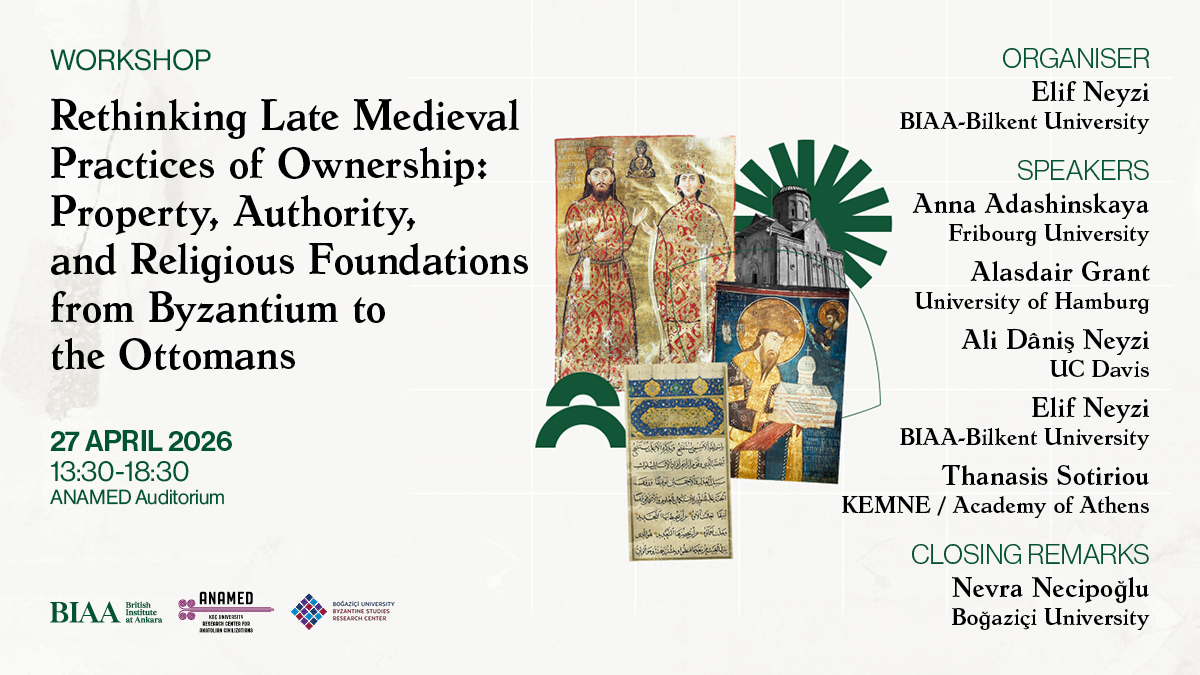
Workshop - "Rethinking Late Medieval Practices of Ownership: Property, Authority, and Religious Foundations from Byzantium to the Ottomans"
Date: 27 April 2026
Time: 13:30–19:00
Venue: ANAMED Auditorium
Address: İstiklal Caddesi No: 181 Merkez Han 34433 Beyoğlu İstanbul
Organizer: Elif Neyzi
Closing Remarks: Nevra Necipoğlu
Land and property ownership is pivotal in discussions on social hierarchies, economic structures, and the role of the state in the economy of medieval societies. This workshop focuses on the relationship between private property ownership and religious and state structures amidst the constantly shifting political territories across the Caucasus, Asia Minor, and the Balkans from the thirteenth to the fifteenth centuries. Five early career researchers revisit the composition and legal nature of wealth and (re-)distribution of properties in Byzantine, Serbian, Armenian, and Ottoman contexts through a combination of legal sources, charters, foundation documents, and historiography. Key discussion points include the composition and legal nature of Byzantine aristocratic landholding; the extent of the Byzantine emperors’ claims of ownership; the discrepancies between the legal terminologies surrounding the ktetorship of religious institutions vis-à-vis the actual practices of the ordinary people, the intricate processes of collective micro-endowments in the transformation of property into social capital that allowed non-elites to exercise limited agency within the aristocratic and ecclesiastical property systems; the transformation of Greater Armenia from a land-based aristocratic society to a commerce- and land-based aristocratic one marked by increased urbanism; and the emergence of Ottoman absolutist claims over medieval legal conventions of ownership in the course of state-building and centralization. Recognizing the potential of interregional studies of the economic histories of medieval and early modern societies across medieval Eurasia, this workshop also inquires whether certain late-medieval modes of ownership were transferred, borrowed, or adopted interculturally.
This in-person event is open to the public, and no registration is required for attendance.
Türkçe simultane tercüme olmayacaktır.
Please click here for the program as well as the abstracts and biographies of the speakers.